

The devices exist, the evidence is clear — so why does use remain so inconsistent? A qualitative study identifies the real barriers and concrete solutions.
🎯 Key Points
- Chest compression feedback devices (CCFDs) improve CPR quality and are recommended by the AHA, but their use in clinical practice remains inconsistent and often abandoned.
- The CPR sensor serves as an emotional buffer: compressing on the sensor is perceived as less intrusive than compressing directly on the patient’s chest — an unexpected facilitator never previously described in the literature.
- Audio feedback is perceived as disruptive by rescuers (tunnel vision, auditory fatigue), while visual feedback is preferred and considered informative — but is not always visible to the right person.
- The most determining factor for consistent use is not technology: it is team organization. The formal assignment of a CPR coach role and the integration of the CCFD into local cardiac arrest protocols transform an underused tool into an essential component of the resuscitation process.
- Clinicians are already questioning the future relevance of current CCFDs in the face of emerging physiology-guided resuscitation (EtCO₂, invasive arterial pressure).
Introduction
The American Heart Association has recommended it since 2020. The European Resuscitation Council confirms it in its 2025 guidelines. Evidence shows that chest compression feedback devices (CCFDs) improve compression depth, rate, and release, and increase the probability of return of spontaneous circulation (ROSC).
And yet, in hospitals and pre-hospital services, these devices are used inconsistently, sometimes removed mid-resuscitation, and often considered “not necessary” by part of the team. In Germany, a registry analysis of 107,548 out-of-hospital cardiac arrest cases showed that CCFDs were used in only a fraction of cases, despite their availability. In Finland, use was described as “low and infrequent.”
How can a tool recommended by the world’s two leading resuscitation organizations be so underused? This is the question Hansen and colleagues posed — not with numbers, but by directly interviewing the clinicians who live this reality every day.
📋 Study Summary
| Field | Details |
| Référence | Hansen ØM, Ingul CB, Storm BS, Solbakken R. Scand J Trauma Resusc Emerg Med (2026). Article in Press. |
| DOI | 10.1186/s13049-026-01607-3 |
| Study Type | Exploratory qualitative study, semi-structured interviews |
| Population | 15 healthcare professionals (4 paramedics, 8 nurses, 2 physicians, 1 emergency medical technician) from 3 Norwegian hospitals and 1 Danish pre-hospital service |
| Instrument | Reflexive thematic analysis (Braun & Clarke), supported by NVivo 15 |
| Journal | Scandinavian Journal of Trauma, Resuscitation and Emergency Medicine (impact factor: 2.75, Q1) |
| Funding | Open Access by Nord University. No conflicts of interest. |
| Reporting | COREQ Checklist |
| Retraction Watch Check | No retraction identified |
Methodology
Design: Exploratory qualitative study adopting a pragmatic philosophical stance, in which knowledge is actively constructed through the exploration of lived experience. Semi-structured interviews were conducted by ØMH (critical care nurse and certified ALS instructor) via Microsoft Teams, from December 2024 to February 2025.
Participants:
| Characteristic | Data |
| Number | 15 (10 in-hospital, 5 pre-hospital) |
| Gender | 7 women, 8 men |
| Median age | 37 years (range 30-59) |
| Median clinical experience | 10 years (range 2-34) |
| Professions | 4 paramedics, 1 emergency medical technician, 2 physicians, 8 nurses |
| Annual participation in resuscitations | 0-5 (n=4), 5-10 (n=6), 10-15 (n=2), 15-20 (n=3) |
| ALS Instructors | 4 participants |
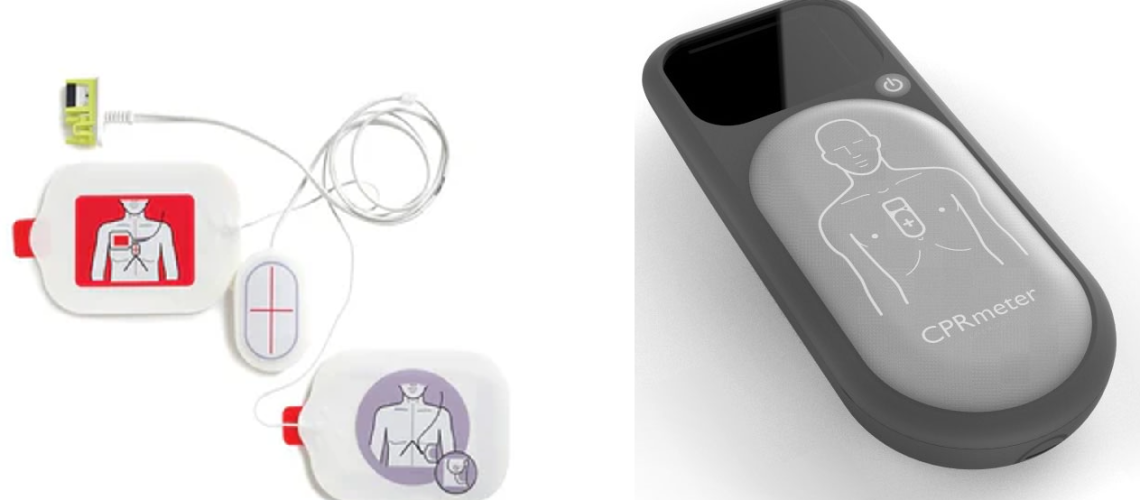
Devices Used: All CCFDs came from ZOLL Medical Corporation. Pre-hospital settings used the ZOLL X Series with CPR Stat-Padz electrodes, and hospital settings the ZOLL R Series with OneStep electrodes. The CPR sensor was integrated into the anterior defibrillation electrode.
Analysis: Six-phase reflexive thematic analysis according to Braun and Clarke (2019), involving all 4 researchers. The final dataset comprised 90,589 words of transcripts.
Quality Assessment Tool: CASP Qualitative Checklist, reported according to COREQ.
Results
The analysis revealed 4 interconnected themes capturing the facilitators and barriers to CCFD use in advanced clinical practice.
Theme 1: The CPR Sensor — A Key Physical Interaction Point
The sensor is the only physical contact point between the rescuer and the device. Its ergonomics largely determine the overall perception of the CCFD.
Facilitators: Participants found compressions more comfortable with the sensor, which provides a light cushion, reduces the angle between the hand and chest, and promotes proper hand positioning. More remarkably, the sensor acted as an “emotional buffer” — compressing on the sensor rather than directly on the patient’s skin reduced the emotional discomfort associated with the feeling of physical intrusion.
« Even after all these years, I still find it deeply unpleasant to compress directly on a patient’s chest. It feels transgressive […] it’s not nearly as invasive when you have the puck in between. » (Participant 13)
Barriers: The sensor frequently moved on diaphoretic patients or when the rescuer changed position. Repositioning compromised its adhesive qualities. In one department, priority given to sensor placement led to suboptimal positioning of defibrillation electrodes. Misplaced or detached sensors caused frustration and were often removed, rendering the CCFD unusable.
Theme 2: Feedback — Device-Rescuer Communication
CCFD feedback functioned simultaneously as facilitator and barrier, depending on its modality.
Visual feedback (facilitator): Generally considered informative, easy to follow, and non-disruptive. Even untrained first responders could be guided by the defibrillator screen to maintain quality compressions.
« We said: ‘You can see how deep you are compressing here.’ Then I noticed that he was like: Okay, fine, now I can… Now I can see what I’m doing, and what I need to do, and I get feedback. » (Participant 11)
Audio feedback (barrier): Rescuers performing compressions often developed “tunnel vision,” reducing their ability to perceive auditory signals. The volume was perceived as excessive by other team members, disrupting communication and creating additional stress.
« The feedback volume was hysterically loud—like level 10. It really stressed people out. It doesn’t matter if you see the value in using the device; it’s not a useful tool if it hurts your ears. » (Participant non identifié)
« …the anesthesiologist said: ‘We need to change the defibrillator. This one is driving me crazy.’ It was constantly talking, and that’s not necessary. » (Participant 8)
In some cases, disruptive audio feedback led to complete sensor removal or use of electrodes without a CPR sensor — eliminating both the barrier AND the benefits of the device.
Theme 3: Cardiac Arrest Management Organization
The most determining factor for consistent CCFD use was not the technology itself, but how the resuscitation team was structured.
Effective model (2 of 3 hospitals + pre-hospital service): The cardiac arrest team operated as two sub-teams: a clinical sub-team (led by the physician, clinical decisions) and a CPR sub-team (led by a CPR coach or paramedic in zone 3, responsible for compression quality, ventilation, defibrillation, and the ALS algorithm). This CPR coach had formal responsibility for compression quality and CCFD use, creating a sense of ownership and accountability. The local protocol defined a fixed defibrillator position relative to the patient, ensuring visual feedback was visible to both the rescuer and the coach.
Ineffective model (1 of 3 hospitals): The team operated as a single unit. No member had specific responsibility for compression quality. The team leader physician was considered “ultimately responsible” but was too busy with clinical decisions to monitor CPR. Responsibility for compression quality was “diffuse and implicitly shared.” The local protocol defined neither mandatory CCFD use nor defibrillator positioning. Result: the defibrillator was sometimes placed so that only the operator could see the screen, electrodes without a CPR sensor were sometimes used, and no one felt responsible for compression quality.
« No, there isn’t anyone dedicated to that, no. There is the team leader, of course—the cardiologist. Although, they use their capacity to find reversible causes… » (Participant 2)
Theme 4: Perceived Utility — An Important Facilitating Factor
Perception of CCFD utility varied according to the professional’s role during resuscitation.
As CPR coach/supervisor: Real-time feedback was highly valued. Access to objective performance data (depth, rate) supported more precise assessment of compression quality. The CCFD also enabled access to complementary defibrillator functions (filtered ECG, algorithm timer), facilitating rhythm assessment and team coordination.
As the rescuer performing compressions: Real-time feedback was less valued. Participants relied more on personal experience and subjective quality assessment. This difference is possibly explained by the high cognitive load associated with performing compressions and physical fatigue.
Questioning future relevance: Several participants had already been guided to adjust compression position based on physiological parameters (EtCO₂, invasive arterial pressure). They felt that individualizing compressions according to physiological response could improve outcomes, and questioned the future relevance of current CCFDs that do not support this approach.
Strengths
- Fills a gap identified by ILCOR: Qualitative research on facilitators and barriers to CCFD use in advanced clinical practice was virtually non-existent. Existing studies were primarily quantitative.
- Diversity of contexts and professions: In-hospital and pre-hospital settings, 4 institutions, 4 different professions. Maximum variation sampling strengthens transferability.
- Methodological rigor: Compliance with COREQ checklist, Lincoln and Guba trustworthiness criteria, reflexive thematic analysis involving 4 researchers with complementary backgrounds (critical care nurse, anesthesiologist-cardiologist, anesthesiologist-quantitative researcher, nurse-qualitative researcher).
- Novel finding: The sensor’s role as an emotional buffer had never been described in the literature — a potentially important facilitator for device design and training.
- Direct clinical relevance: The identified themes lead to concrete, actionable recommendations (CPR coach role, defibrillator positioning, local protocols).
Limitations
- Small sample and restricted geographic context (selection bias). 15 participants from Norway and Denmark, all experienced. The perspectives of novice clinicians, healthcare systems with limited resources, or non-Scandinavian contexts are not represented. However, information power is a recognized methodological criterion in qualitative research and the authors justify their sample size.
- Single CCFD manufacturer (device bias). All participants used ZOLL devices. Experiences may differ with other manufacturers (Philips, Stryker/Physio-Control, Laerdal) whose sensors, feedback modalities, and defibrillator integration vary considerably. Generalizability of findings to other systems is uncertain.
- No participant validation (member checking). In accordance with Braun and Clarke’s methodology, transcripts and analysis were not returned to participants for validation. While this approach is consistent with the chosen epistemological stance (the researcher’s interpretive role prevails), it limits verification of interpretive fidelity.
- Digital interviews (observation bias). Interviews via Microsoft Teams limit the ability to observe body language. The authors acknowledge this limitation but argue that the digital format may have increased participant comfort and openness.
- No quantification of described phenomena. The study does not allow determination of the frequency or prevalence of identified facilitators and barriers. It is unknown, for example, what proportion of resuscitations are affected by sensor removal or disruption from audio feedback.
Discussion
What the study shows. Successful CCFD implementation does not depend solely on available technology — it depends fundamentally on how the resuscitation team is organized. The two-sub-team structure with a formal CPR coach role appears as the most powerful facilitator for consistent and effective device use.
Why this matters. Hospitals invest in defibrillators with integrated CPR sensors, but without the organizational conditions necessary for these devices to actually be used. This study shows that technological investment is insufficient without organizational investment: defined roles, explicit protocols, standardized equipment positioning.
What may be misinterpreted. It would be wrong to conclude that CCFDs are useless or that audio feedback should be systematically disabled. Evidence suggests that combined audio-visual feedback is more effective than visual feedback alone for patient outcomes. The challenge is finding a balance between the amount of information delivered and team disruption — possibly by directing different feedback modalities to different team members.
What the study does not allow us to conclude. The clinical impact of identified barriers cannot be quantified. The study does not measure whether hospitals with a sub-team structure and CPR coach achieve better patient outcomes than those without this structure. The causal link between team organization, CCFD use, CPR quality, and survival remains to be demonstrated.
Canadian perspective and link to SCORE. The challenges described in this study are exactly those observed in Canadian hospitals. The SCORE program integrates precisely this logic: compression quality is a fundamental pillar, and team coordination — including a dedicated role for CPR quality supervision — is essential to transform technological availability into real clinical use. The CPR coach concept described in this study is directly aligned with SCORE’s principles. Hansen et al. recommendations constitute a practical roadmap for hospitals that already have CCFDs but are not exploiting them to their full potential.
Authors’ Conclusion
“This study identified key enablers and barriers to the use of chest compression feedback devices in advanced life support. Usability of the CPR sensor, clarity of feedback, and team organization emerged as critical factors influencing both implementation and sustained use. […] Successful implementation of chest compression feedback devices requires user-centered design, role-sensitive feedback modalities, and context-specific protocols.” (p. 32)
Our Conclusion
This qualitative study is exactly the type of research the field needed. We have known for years that CCFDs improve CPR quality. We know the AHA recommends them. But we continued to observe a massive gap between recommendation and practice. Hansen and colleagues finally provide concrete explanations, grounded in clinicians’ lived experience.
The most striking finding, and probably the most actionable, is the importance of team structure. It is not the device that makes the difference — it is having a specific person responsible for compression quality with the tools to fulfill that role. Without this structure, the CCFD is a wasted investment.
In light of this evidence, here is what I would do in practice today: 1. I would formalize the CPR coach role in each unit’s cardiac arrest protocol, with explicit responsibility for monitoring compression quality via the CCFD. 2. I would standardize defibrillator positioning relative to the patient to ensure the feedback screen is visible to both the CPR coach and the rescuer. 3. I would reduce the audio feedback volume or explore visual feedback configurations directed toward the coach rather than broadcast to the entire team. 4. I would integrate CCFD use into simulation training, specifically including scenarios where the CPR coach uses the device data to guide the team.
The discovery of the sensor’s “emotional buffer” role is fascinating and deserves further exploration. If the sensor helps rescuers maintain focus by reducing emotional discomfort, this is an additional argument for its systematic use — an argument that speaks to clinicians’ lived experience, not just quality metrics.
💊 Clinical Bottom Line
CCFDs improve CPR quality, but their use in practice depends on precise organizational conditions: a formal CPR coach role, standardized defibrillator positioning, and local protocols that explicitly integrate the device. Visual feedback is preferred and informative; audio feedback is often disruptive and can lead to device removal. For every dollar invested in technology, invest a dollar in team organization.
